
Ensemble Learning for Masked Face Recognition
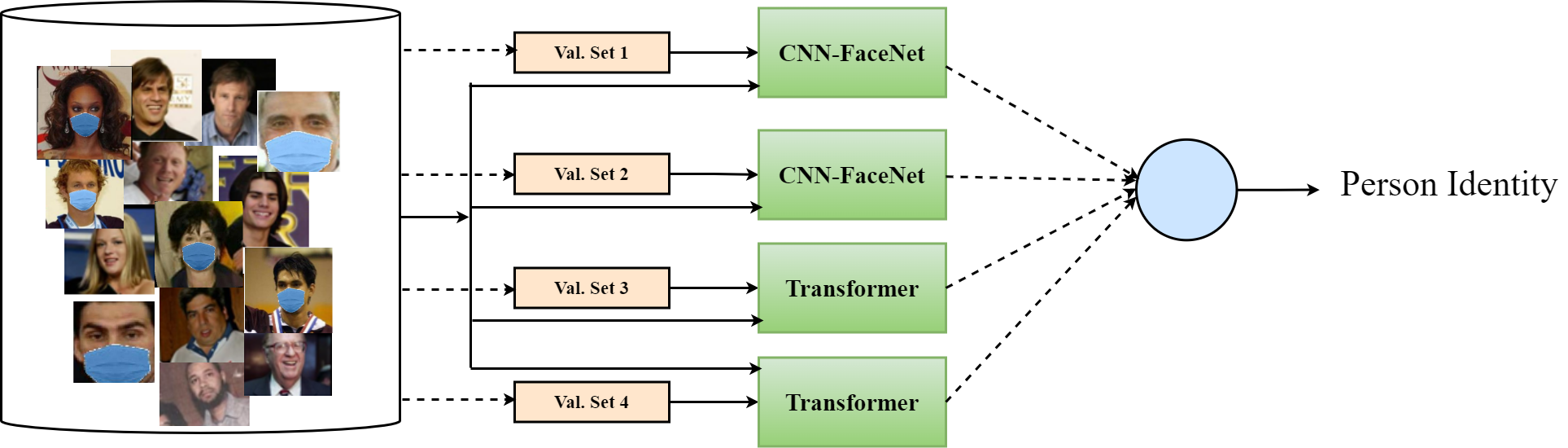
Developed an advanced ensemble learning system combining Transformers and Convolutional Neural Networks for masked face recognition, achieving 94.22% accuracy through innovative stacking techniques. The project enhanced existing methodologies by implementing optimized weight distribution and stacked generalization, demonstrating significant improvements over state-of-the-art approaches. Notable achievements included a 2.2% accuracy gain over traditional ensemble methods and robust performance across multiple datasets.
Overview
The project addresses the critical challenge of face recognition systems’ performance degradation when dealing with masked faces, particularly relevant during the COVID-19 pandemic. By combining CNN architectures with Transformer models, the system achieves superior recognition capabilities for occluded faces. The research focused on developing an ensemble approach that leverages the strengths of both deep learning paradigms, implementing innovative weighting strategies and stacking techniques to enhance performance beyond existing solutions.
Technologies
- Programming: Python
- Data Processing: NumPy, Pandas
- Visualization: Matplotlib, TensorBoard
- Model Architectures: Transformers, CNNs
- Machine Learning: Scikit-learn
- Deep Learning Frameworks: PyTorch, TensorFlow
- Pre-trained Models: FaceNet, VGG16, EfficientNet
Implementation Details
1. Model Architecture Development
- Fine-tuned multiple CNN models (VGG16, EfficientNet, FaceNet) for feature extraction
- Added dropout and batch normalization layers to prevent overfitting
- Developed custom classification layers with Softmax activation
2. Transformer Enhancement
- Modified traditional Transformer architecture for image batch processing
- Developed multi-head attention mechanism with residual connections
- Integrated layer normalization units for stable training
3. Ensemble Integration
- Implemented two distinct ensemble approaches: weighted average and stacking
- Integrated Logistic Regression meta-learner for stacked generalization
- Created voting mechanism for model prediction combination
4. Performance Optimization
- Developed grid search algorithm for optimal weight determination
- Fine-tuned hyperparameters for individual models and ensemble
- Implemented cross-validation strategy for robust evaluation
- Developed custom metrics for performance monitoring
Analysis Features
- Comparative analysis of different CNN architectures
- Performance evaluation and Model robustness testing across multiple datasets (LFW, MAFA, RFMR)
- Grid search optimization for ensemble weights
- Stacked generalization performance analysis
- Cross-dataset validation
- Feature importance visualization
- Attention map analysis
Skills Gained
- Neural network architecture design and implementation of CNNs and Transformers
- Transfer learning with pre-trained models (FaceNet, VGG16, EfficientNet)
- Model fine-tuning and hyperparameter optimization
- Feature extraction and embedding generation
- Image preprocessing and augmentation techniques
- Ensemble learning strategies including weighted averaging and stacked generalization
- Model optimization and hyperparameter tuning for production deployment
- GPU utilization and parallel processing
- Large-scale training pipeline development
- Scientific paper implementation and enhancement
- Experiment design and validation
- Performance comparison with state-of-the-art methods
Key Results
- Obtained 98.12% top-5 accuracy for masked face recognition
- Identified optimal model weights through grid search (FaceNet: 0.25/0.25, Transformer: 0.28/0.22)
- Achieved 94.22% top-1 accuracy with stacked ensemble approach, demonstrating 2.2% improvement over traditional ensemble methods
- Improved performance over single model approaches (CNN-FaceNet: 80.30%, Transformer: 69.04%)
- Achieved superior performance compared to the current state-of-the-art methods
- Validated robust performance across multiple datasets
- Demonstrated effective handling of various mask types and occlusions
- Reduced false positive rates compared to existing solutions
Impact
The system provides a robust solution for masked face recognition, particularly valuable for security and identification systems during pandemic conditions. The methodology demonstrates the effectiveness of combining traditional CNNs with modern Transformer architectures, offering insights for future computer vision applications. The improvements in accuracy and robustness make the system suitable for real-world deployment in various scenarios.